Introduction
RankNexa is a digital marketing team that builds and runs SEO, paid media, social and content programs for businesses across industries — from local service providers and educational institutions to eCommerce brands and growing enterprises. The recommendations and frameworks in this guide come from campaigns we’ve actually planned and managed, not just theory.
Digital marketing has become an essential part of how businesses attract customers, generate leads, build brand visibility and increase revenue. Whether you are a startup, small business, local company, educational institution, eCommerce brand or established enterprise, the right digital marketing strategy can help you reach potential customers at different stages of their buying journey.
At RankNexa, we believe digital marketing should not be limited to generating website traffic or social media engagement. A successful strategy connects visibility, traffic, leads, conversions and measurable business growth.
In this guide, we explain the major digital marketing channels, how they work together, how to build a strategy and how businesses can measure their results.
How We Built This Guide
We structured this guide around how a real strategy actually gets built, not around isolated tactics. Each channel below is evaluated against the same set of questions:
- What is it best for — the specific business objective it serves
- How it fits the funnel — awareness, consideration, conversion or retention
- What it takes to do well — the activities and consistency required
- Who should prioritise it — business type, budget and stage
- Where businesses go wrong — common execution mistakes
Costs, platforms and best practices referenced in this guide reflect general 2026 conditions and change over time — treat this as a strategic framework rather than a fixed playbook.
What Is Digital Marketing?
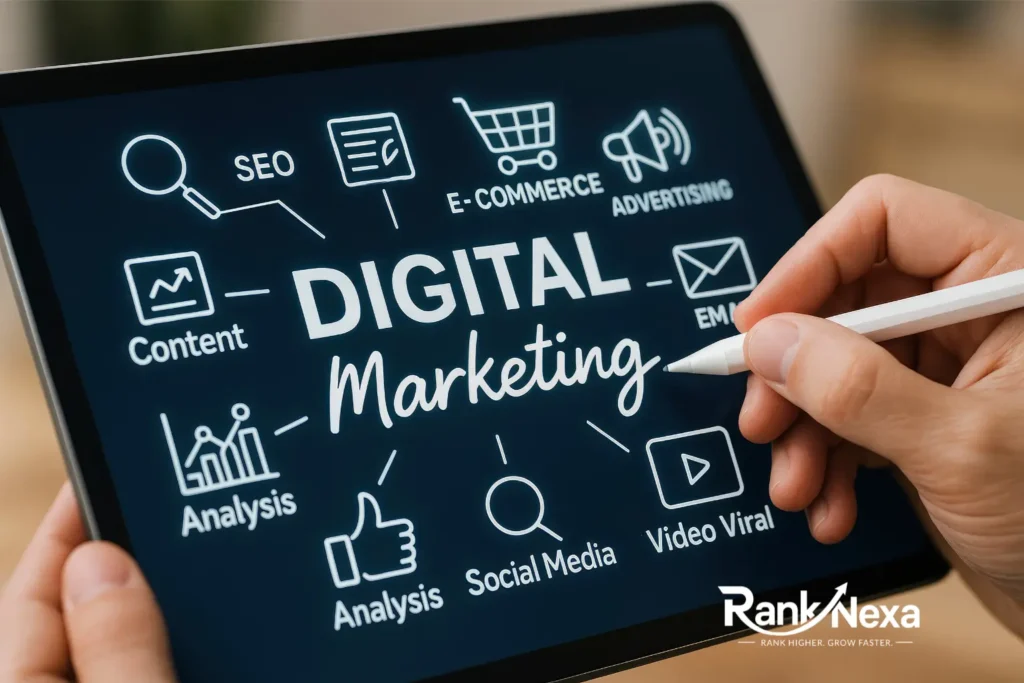
Digital marketing is the process of promoting products, services or brands through digital channels such as search engines, websites, social media platforms, paid advertising, email, messaging platforms and online content.
Unlike traditional marketing, digital marketing allows businesses to:
- Reach highly targeted audiences
- Track campaigns and user behaviour
- Measure leads and conversions
- Test different messages and creatives
- Retarget potential customers
- Optimise campaigns based on performance
- Build long-term organic visibility
A strong digital marketing strategy combines multiple channels rather than depending on one source of traffic.
Why Is Digital Marketing Important for Businesses?
Businesses today need to be visible where their customers are searching, researching and making purchasing decisions.
1. Reach Your Target Audience
Digital channels allow businesses to target customers based on factors such as location, search intent, interests, demographics, online behaviour, previous website interactions and professional characteristics.
2. Generate Qualified Leads
Instead of reaching everyone, businesses can focus their marketing efforts on people who are more likely to become customers.
3. Build Brand Awareness
Consistent SEO, social media, content and advertising activity can improve brand recognition and credibility.
4. Increase Website Traffic
A combination of SEO, paid search, social media, content and referral marketing can generate qualified website visitors.
5. Measure Marketing Performance
Digital marketing provides measurable data such as impressions, clicks, CTR, website sessions, leads, conversion rate, cost per lead, customer acquisition cost, revenue and ROAS.
What Are the Major Digital Marketing Channels?
A complete digital marketing strategy can include several channels working together. Below, we break each one down the way we would when planning a client strategy.
1. Search Engine Optimization (SEO)
Best for: Long-term, compounding organic visibility
SEO helps websites improve their organic visibility on search engines through a mix of technical, content and authority-building work.
- Key activities:
- Keyword research and search intent analysis
- Technical SEO
- On-page SEO
- Content marketing
- Internal linking
- Local SEO
- Digital PR and link building
- Conversion optimisation
Why it works: SEO builds an asset that keeps generating traffic without ongoing ad spend, and it compounds — pages built well in year one often keep ranking and improving in year two.
Where it needs care: results take months, not days, and success depends on consistent execution across technical, content and authority work.
Best suited for: businesses planning for sustainable, long-term customer acquisition rather than only immediate traffic.
Our take: treat SEO as infrastructure, not a campaign. It should run continuously alongside paid channels, not instead of them.
Explore our Search Engine Optimization (SEO) services.
2. Google Ads & Paid Search
Best for: Immediate visibility for high-intent searches
Google Ads can help businesses appear when potential customers actively search for relevant products or services.
- Key activities:
- Search Ads
- Performance Max
- Shopping Ads
- Display Ads
- YouTube Ads
- Remarketing
Why it works: it’s the fastest way to appear in front of people who are already searching for what you offer, and results are measurable from day one.
Where it needs care: cost per click rises with competition, and campaigns without proper conversion tracking and landing pages can burn budget quickly.
Best suited for: businesses that need immediate traffic and lead generation, or want to test demand before investing in long-term SEO.
Our take: pair every campaign with accurate conversion tracking and a landing page built for the specific search intent — the ad only does half the job.
Explore our Google Ads & Paid Search services.
3. Social Media Marketing
Best for: Brand building, community and engagement
Social media marketing helps businesses build awareness, engagement and communities around their brands across platforms like Instagram, Facebook, LinkedIn, YouTube, X and Pinterest.
- Key activities:
- Content strategy and creative production
- Community management
- Organic distribution
- Paid promotion
- Performance analytics
Why it works: it builds direct, ongoing relationships with an audience rather than one-off transactions, and strong content compounds through shares and engagement.
Where it needs care: organic reach is limited on most platforms today, so paid promotion is usually needed to scale beyond an existing following.
Best suited for: brands that need to build recognition, trust and community over time, especially consumer-facing businesses.
Our take: the strongest social strategy combines content, community, distribution, paid promotion and analytics — not just posting on a schedule.
Explore our Social Media Marketing services.
4. Meta Ads
Best for: Precise audience targeting across Facebook and Instagram
Meta Ads can help businesses reach specific audience segments across Facebook and Instagram for objectives ranging from lead generation to remarketing.
- Key activities:
- Lead generation campaigns
- Website conversion campaigns
- Traffic and brand awareness campaigns
- Engagement and video view campaigns
- Remarketing
Why it works: Meta’s targeting and creative formats make it efficient for reaching specific audience segments at scale, particularly for visual products and services.
Where it needs care: lead quality varies widely without a proper CRM and fast follow-up process — Meta Ads generate volume, but conversion depends on what happens after the lead comes in.
Best suited for: lead-generation and eCommerce businesses that can move quickly on follow-up.
Our take: connect every Meta lead campaign to a CRM with an automated, fast follow-up process — the ad platform can’t fix a slow sales response.
5. WhatsApp Marketing & WhatsApp Ads
Best for: Direct conversations and lead nurturing
WhatsApp can play an important role in lead nurturing and customer communication, especially in markets where it’s a primary messaging channel.
- Key activities:
- Lead follow-up and enquiry management
- Product communication and offers
- Appointment reminders
- Customer support
- Retargeting and automated conversations
Why it works: it moves conversations out of impersonal ad platforms and into a direct, high-response-rate channel prospects already use daily.
Where it needs care: requires careful process design so automation feels helpful rather than spammy, and message templates need approval.
Best suited for: businesses with a sales or enquiry process that benefits from real-time, direct conversation.
Our take: use WhatsApp Ads to move prospects from advertising platforms straight into a conversation — it shortens the path from interest to enquiry.
6. Email Marketing
Best for: Nurturing prospects and retaining customers
Email marketing can help businesses nurture prospects and existing customers through welcome sequences, promotions and re-engagement campaigns.
- Key activities:
- Welcome and onboarding emails
- Lead nurturing sequences
- Product updates and newsletters
- Promotional campaigns
- Abandoned-cart and re-engagement emails
Why it works: it’s one of the most cost-efficient channels for retention, and segmentation lets you send genuinely relevant messages rather than generic blasts.
Where it needs care: the objective shouldn’t be sending more emails — low-relevance email programs see declining engagement and rising unsubscribe rates.
Best suited for: businesses with an existing list or ongoing customer relationship worth nurturing.
Our take: focus on relevance and measurable actions per email, not volume — a smaller, engaged list outperforms a large, disengaged one.
7. Content Marketing
Best for: Answering customer questions across the buying journey
Content marketing helps businesses answer customer questions before and during the buying process through blogs, guides, case studies, videos and more.
- Key activities:
- Blog posts and guides
- Case studies and testimonials
- Videos and infographics
- eBooks and checklists
- Comparison pages and FAQs
Why it works: it builds authority and answers objections at scale, and it feeds both SEO and social distribution simultaneously.
Where it needs care: content without a clear connection to target keywords and the customer journey tends to generate traffic without generating leads.
Best suited for: businesses in considered-purchase categories where buyers research before deciding.
Our take: map every piece of content to a specific stage of the customer journey and a specific keyword or question — content without a purpose rarely performs.
8. Local SEO
Best for: Visibility for city- and location-specific searches
Local SEO is important for businesses serving specific cities, locations or service areas, built around Google Business Profile optimisation and location-specific content.
- Key activities:
- Google Business Profile optimisation
- Local keyword targeting and location pages
- Reviews and local citations
- NAP consistency
- Local backlinks and local content
Why it works: local intent searches convert at high rates because the searcher is often ready to buy or visit — a business targeting Bengaluru, for example, benefits from dedicated content around relevant services and locations.
Where it needs care: requires ongoing review management and consistent business information across directories — inconsistency quietly erodes local rankings.
Best suited for: businesses with a physical location or defined service area.
Our take: treat Google Business Profile as an active channel, not a one-time setup — regular updates, posts and review responses genuinely move rankings.
9. LinkedIn Marketing & LinkedIn Ads
Best for: B2B brand building and lead generation
LinkedIn is particularly valuable for B2B businesses, professional services, technology companies and enterprise solutions.
- Key activities:
- Brand and founder-led content
- Lead generation campaigns
- Account-based marketing
- Recruitment marketing
- B2B advertising
Why it works: LinkedIn’s professional targeting reaches decision-makers directly, and founder-led content often outperforms brand-page content for reach and trust.
Where it needs care: CPCs run higher than most other platforms, so campaigns need tight targeting and a clear offer to justify the cost.
Best suited for: B2B businesses, professional services and enterprise-focused brands.
Our take: combine consistent organic founder/brand content with targeted ABM campaigns — LinkedIn rewards a real presence, not just ad spend.
10. Influencer Marketing
Best for: Reaching established, niche communities
Influencer marketing can help businesses reach established communities and niche audiences through creators with relevant, engaged followings.
- Key activities:
- Creator identification and vetting
- Campaign briefing and content collaboration
- Performance tracking
- Usage rights and repurposing
Why it works: it borrows trust an audience has already built with a creator, which is harder to manufacture through ads alone.
Where it needs care: follower count alone doesn’t predict performance — audience relevance, engagement quality and brand fit matter far more.
Best suited for: consumer brands, and any business targeting audiences that gather around specific creators or niches.
Our take: select influencers based on audience relevance, engagement quality and content fit, not follower count — a smaller, relevant audience usually converts better.
How to Create a Digital Marketing Strategy
A successful strategy starts with business objectives rather than individual marketing channels.
Step 1: Define Your Business Goals
Your objective could be to generate leads, increase sales, improve brand awareness, increase website traffic, enter a new market, increase repeat purchases or improve customer acquisition. Make the objective measurable.
Step 2: Identify Your Target Audience
Define who your customers are, what problems they have, what they’re searching for, which platforms they use, what influences their buying decision, and what objections prevent them from purchasing.
Step 3: Research Your Competitors
Analyse competitors for organic rankings, paid advertising, content, social media, backlinks, landing pages, offers, reviews and brand positioning. The goal isn’t to copy competitors — it’s to identify market opportunities and content gaps.
Step 4: Conduct Keyword Research
Group keywords according to search intent:
- Informational: “what is digital marketing”
- Commercial investigation: “best digital marketing agency in Bangalore”
- Transactional: “digital marketing services Bangalore”
- Local: “digital marketing company near me”
This keyword structure can then be mapped to your website pages.
Step 5: Build Your Website & Landing Pages
Your website should clearly communicate what you offer, who you serve, why customers should choose you, your expertise, your process, your results, FAQs and contact options. Each major service should ideally have a dedicated, optimised page.
SEO vs Google Ads vs Social Media – Which Is Better?
There is no single channel that is best for every business.
| Channel | Best For | Typical Strength |
|---|---|---|
| SEO | Long-term organic growth | Sustainable visibility |
| Google Ads | High-intent searches | Faster traffic |
| Meta Ads | Audience targeting & leads | Scalable acquisition |
| LinkedIn Ads | B2B | Professional targeting |
| Social Media | Brand & community | Engagement |
| Nurturing | Retention | |
| Conversations & follow-up | Lead nurturing | |
| Content Marketing | Education & authority | Long-term demand |
The strongest strategy often combines multiple channels according to the business’s goals, budget and customer journey.
How SEO, Paid Ads and Social Media Work Together
Awareness — Social Media → Video → Content → Display
Consideration — Google Search → Blog → Case Study → Comparison
Conversion — Landing Page → Lead Form → WhatsApp → Sales Team
Retention — Email → WhatsApp → Remarketing → Customer Support
This creates an integrated digital marketing funnel rather than isolated campaigns.
Digital Marketing Funnel
Top of Funnel – Awareness
Objective: Make your target audience aware of your brand.
Channels: SEO, social media, YouTube, display, influencer marketing
Middle of Funnel – Consideration
Objective: Help potential customers evaluate your solution.
Content: Blogs, case studies, guides, webinars, comparison pages, testimonials
Bottom of Funnel – Conversion
Objective: Turn prospects into customers.
Tools: Google Ads, landing pages, lead forms, WhatsApp, remarketing, sales follow-up
What Is Generative Engine Optimization (GEO)?
Search behaviour is increasingly expanding beyond traditional search engine result pages. People may ask AI systems questions such as “What is the best digital marketing agency in Bangalore?”, “Which agency provides SEO and Google Ads?” or “How can a small business generate leads online?”
Generative Engine Optimization focuses on making information clear, authoritative, structured and useful enough to be understood and potentially surfaced by AI-powered search experiences.
How to Optimise Content for GEO
- First-hand expertise
- Clear, direct answers
- Structured headings
- Entity clarity and author information
- Original research and case studies
- Statistics with credible sources
- FAQs and consistent business information
What Is Answer Engine Optimization (AEO)?
AEO focuses on creating content that directly answers questions users ask through search engines and answer-based platforms.
Question: What does a digital marketing agency do?
Answer: A digital marketing agency helps businesses attract, engage and convert customers through channels such as SEO, paid advertising, social media, content marketing, email marketing and other digital platforms.
Use concise answer blocks throughout an article to improve its usefulness for answer-based searches.
How AI Is Changing Digital Marketing
AI is changing how businesses research audiences, create content, analyse data and optimise campaigns. Businesses can use AI to assist with keyword research, content ideation, customer segmentation, ad copy variations, creative concepts, data analysis, lead qualification, marketing automation and reporting.
However, AI-generated content should still be reviewed by experienced marketers for accuracy, originality, brand alignment and real-world usefulness.
How to Measure Digital Marketing Performance
Traffic alone doesn’t determine marketing success. Track metrics across the entire funnel.
SEO KPIs
Organic clicks, organic impressions, rankings, non-brand traffic, qualified organic leads, conversion rate, indexed pages
Google Ads KPIs
Impressions, CTR, CPC, conversions, conversion rate, cost per conversion, ROAS
Meta Ads KPIs
Reach, impressions, CTR, leads, cost per lead, lead quality, conversion rate
Business KPIs
Ultimately, connect marketing metrics to qualified leads, sales, revenue, customer acquisition cost, customer lifetime value and return on marketing investment.
Common Digital Marketing Mistakes Businesses Should Avoid
- Focusing only on traffic — more traffic does not automatically mean more customers.
- Targeting too many keywords — focus on keywords that match your products, services and customer intent.
- Running ads without conversion tracking — without accurate tracking, it’s difficult to understand campaign profitability.
- Ignoring landing page experience — even a good campaign can fail when the landing page is slow, unclear or poorly structured.
- Not following up with leads — generating a lead is only the beginning.
- Depending on one marketing channel — a diversified acquisition strategy reduces dependency on a single source.
How Much Does Digital Marketing Cost in Bangalore?
The cost of digital marketing depends on factors such as business objectives, industry, target location, competition, number of services, advertising budget, content requirements, SEO competition, lead volume and expected growth.
Instead of choosing an agency purely based on the lowest monthly fee, businesses should evaluate strategy, expertise, transparency, reporting and measurable outcomes.
Looking for a digital marketing strategy tailored to your business? Talk to RankNexa about your goals, target audience and growth opportunities.
Why Choose RankNexa for Digital Marketing?
RankNexa takes an integrated approach to digital growth rather than treating every marketing channel separately.
Our services include SEO, Local SEO, GEO, AEO, Google Ads, Meta Ads, WhatsApp Ads, Social Media Marketing, LinkedIn Ads, Content Marketing, Email Marketing, Influencer Marketing, Web Design & Development, and Analytics & Conversion Tracking.
Our approach focuses on connecting strategy → visibility → traffic → leads → conversions → growth.
Our Digital Marketing Process
- Business & Market Analysis — Understand your business, customers, competitors and market.
- Digital Audit — Analyse your website, SEO, paid campaigns, social media, analytics and conversion journey.
- Strategy Development — Create a channel-wise strategy based on business objectives.
- Implementation — Execute SEO, content, paid advertising, social media and other activities.
- Measurement — Track leads, conversions, costs and revenue.
- Optimisation — Continuously improve campaigns and content based on performance data.
Frequently Asked Questions
What is digital marketing?
Digital marketing is the promotion of products, services and brands through digital channels such as search engines, websites, social media, paid advertising, email and messaging platforms.
Which digital marketing channel is best for a business?
There is no universal best channel. The right mix depends on the business model, target audience, competition, budget and customer journey.
How long does SEO take to produce results?
SEO is generally a long-term strategy. The timeline depends on competition, website authority, technical health, content quality, backlinks and the target keywords.
Is Google Ads better than SEO?
Google Ads can provide faster visibility, while SEO can build long-term organic visibility. Many businesses benefit from using both.
How can businesses generate leads through digital marketing?
Businesses can combine SEO, Google Ads, Meta Ads, LinkedIn Ads, landing pages, WhatsApp, email marketing, content marketing and remarketing to generate and nurture leads.
How much should a business spend on digital marketing?
There is no fixed amount. The appropriate budget depends on business objectives, market competition, customer acquisition economics and expected return.
Does RankNexa provide digital marketing services in Bangalore?
Yes. RankNexa provides digital marketing solutions including SEO, paid advertising, social media marketing, content marketing, web solutions and other digital growth services.